How to Lower Customer Acquisition Cost Effectively


Discover proven strategies to lower customer acquisition cost and boost your ROI. Optimize marketing efforts today!
Stop Bleeding Money: Conquer Your Customer Acquisition Costs
Acquiring new customers is essential, but high costs can cripple growth. This listicle reveals seven proven strategies to lower customer acquisition cost (CAC) and boost your bottom line. Learn how to leverage referrals, optimize content for SEO, improve customer retention, build communities, form strategic partnerships, implement freemium models, and automate marketing. These tactics will help businesses of all sizes transform CAC into a source of profit. Let's dive in.
1. Referral Marketing Programs
One of the most effective ways to lower customer acquisition cost (CAC) is through referral marketing programs. This strategy leverages the power of word-of-mouth marketing by incentivizing your existing customers to refer new customers. Customers receive rewards, such as discounts, free products, or credits, for referring friends, family, or colleagues who then make a purchase. This approach capitalizes on the inherent trust people place in personal recommendations, resulting in higher conversion rates compared to traditional marketing efforts.
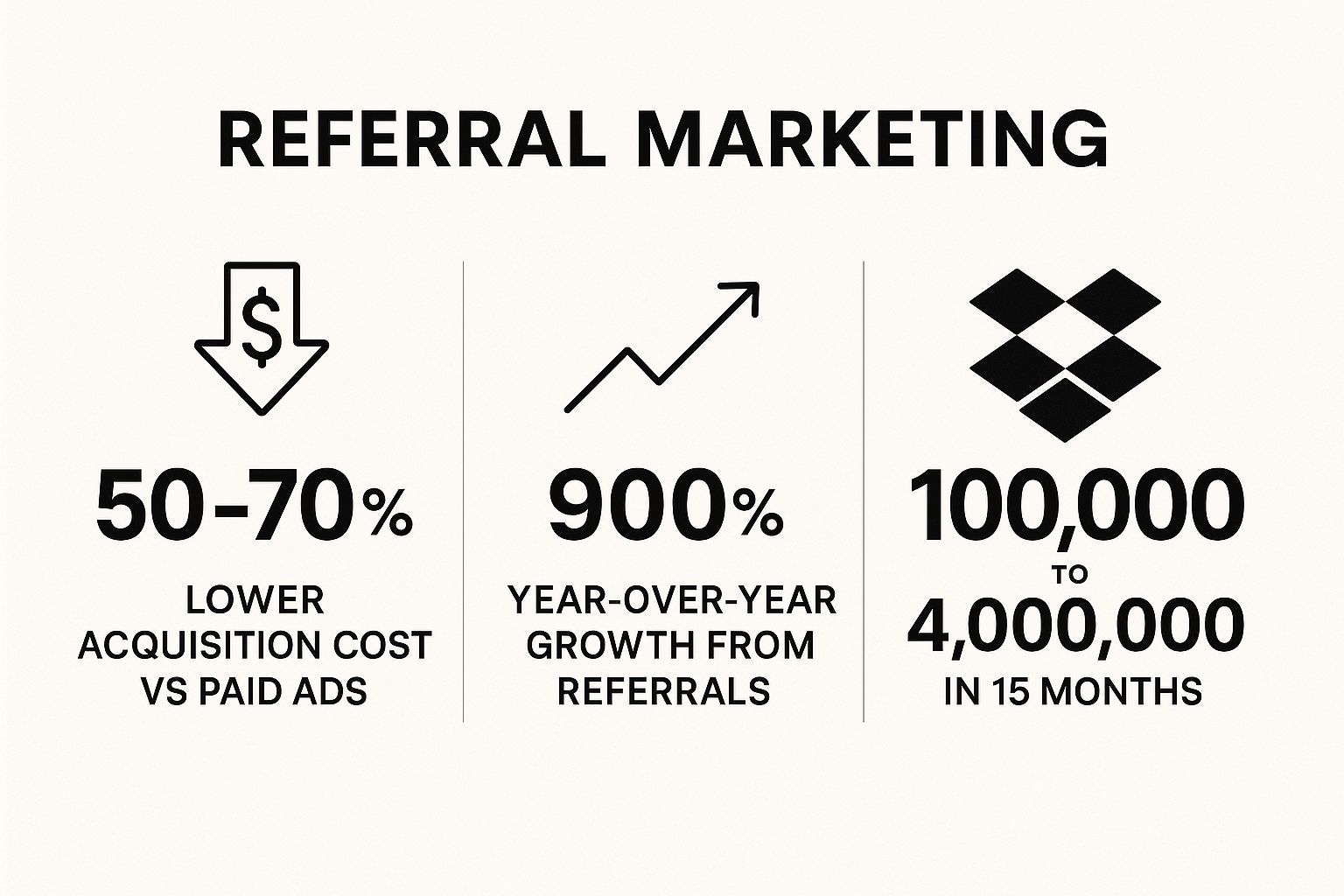
The infographic above visualizes key statistics demonstrating the power of referral marketing.
Referral programs offer a range of features to streamline the process and maximize effectiveness. These include a two-sided incentive structure rewarding both the referrer and the referee, trackable referral links or codes for accurate attribution, automated reward fulfillment to minimize administrative overhead, gamification elements to boost engagement, and seamless social sharing integration to amplify reach. This makes it easy for customers to spread the word about your brand.
This data highlights the significant impact of referral marketing. The 74% statistic emphasizes the importance placed on recommendations from personal networks, while the increased customer lifetime value and faster close rates underscore the high quality of referred customers. The 65% stat reinforces that customers acquired through referrals are more loyal, contributing to long-term business success. Lastly, the reduction in CAC by 50-70% demonstrates the significant cost savings referral programs can offer.
Why Referral Marketing Deserves Its Place in the List: Simply put, referral marketing offers a potent combination of lower CAC, higher customer lifetime value (CLTV), and increased customer loyalty. By turning your existing customers into brand advocates, you tap into a highly effective and cost-efficient acquisition channel.
Pros:
- Lower acquisition costs: Typically 50-70% less than paid advertising.
- Higher customer lifetime value: Referred customers tend to be more valuable in the long run.
- Built-in trust factor: Personal recommendations carry more weight than generic advertisements.
- Scalable with customer base growth: The larger your customer base, the more potential referrers you have.
- Creates additional value for existing customers: Rewards enhance customer loyalty and engagement.
Cons:
- Requires an established customer base: Less effective for brand new businesses.
- Program setup and management requires resources: Time investment is needed for implementation and tracking.
- Potential for fraud or gaming the system: Monitoring is crucial to prevent abuse.
- May not work effectively for all business models: Suitability depends on the product/service and target audience.
- Results can take time to materialize: Building momentum requires consistent effort.
Examples of Successful Implementation:
- Dropbox: Their referral program, offering free storage space, fueled explosive growth from 100,000 to 4 million users in just 15 months.
- Airbnb: Their referral program contributed to a staggering 900% year-over-year growth.
- PayPal: Their famous "Give $10, Get $10" program helped them achieve 7-10% daily growth.
- Harry's: They collected 100,000 email addresses in one week before launch through referrals.
Tips for Success:
- Make rewards valuable but economically sustainable: Find the sweet spot between attracting referrals and maintaining profitability.
- Simplify the referral process: The easier it is to refer, the higher the participation rate.
- Test different incentive structures: Experiment to find what resonates best with your audience.
- Promote the program across multiple touchpoints: Ensure visibility across your website, email marketing, and social media.
- Track and analyze program performance metrics: Monitor key data to optimize your strategy.
- Celebrate successful referrers: Public acknowledgment encourages continued participation.
When and Why to Use This Approach:
Referral marketing is particularly effective when you have a product or service that customers are likely to recommend. It’s ideal for businesses with an established customer base and a focus on building long-term customer relationships. If you’re looking to lower CAC, increase CLTV, and foster customer loyalty, a well-executed referral program can be a game-changer. However, it’s crucial to acknowledge that it requires an initial investment of time and resources, and results may not be immediate.
2. Content Marketing & SEO
Content marketing, combined with a strong SEO strategy, is a powerful way to lower customer acquisition cost (CAC). This approach focuses on creating valuable, relevant content that organically attracts and engages your target audience. Instead of paying for each visitor through advertising, you're providing helpful information that draws them in naturally. By optimizing this content for search engines, you can improve your visibility in search results and drive qualified traffic to your website. Over time, this builds authority in your industry and significantly reduces CAC while creating a sustainable stream of potential customers.

This method deserves a spot on this list because it offers a long-term, sustainable solution to lowering CAC. Unlike paid advertising, which stops generating traffic as soon as the budget runs out, content marketing provides compounding returns. The content you create today can continue to attract visitors and generate leads for months or even years to come.
Content marketing encompasses various formats, including long-form educational content like blog posts, in-depth guides, and whitepapers. It also includes multimedia content formats like videos, audio content, and infographics. Key features of effective content marketing for lowering CAC include keyword optimization to ensure your content ranks well in search results, technical SEO implementation for website optimization, content distribution across owned channels (website, social media, email), and adhering to a consistent publishing schedule. This consistency is vital for building momentum and keeping your audience engaged.
Examples of Successful Implementation:
- HubSpot: A prime example of inbound marketing success, HubSpot grew into a multi-billion dollar company largely through content marketing. Their extensive blog, resources, and free tools attract thousands of potential customers daily.
- Ahrefs: Their blog and YouTube channel, packed with valuable SEO and marketing insights, generate a significant number of qualified leads each month.
- Shopify: Their comprehensive resource library helps them dominate e-commerce related search engine results pages (SERPs), drawing in entrepreneurs and business owners looking to start or grow their online stores.
Pros:
- Generates compounding returns over time
- Builds brand authority and trust
- Creates assets with long-term value
- Attracts pre-qualified prospects
- Scalable with relatively fixed costs
- Provides multiple opportunities for conversion
Cons:
- Requires significant time investment before seeing results
- Needs consistent quality content creation
- Competitive keywords can be difficult to rank for
- Algorithm changes can affect performance
- Requires specialized skills or resources
- ROI can be difficult to measure precisely
Actionable Tips:
- Focus on solving customer problems: Address their pain points and provide valuable solutions.
- Create content clusters around main topic pillars: This creates a network of interlinked content, boosting SEO and user experience.
- Update high-performing content regularly: Keep it fresh and relevant.
- Optimize for featured snippets and position zero: Aim for the top spot in search results.
- Leverage internal linking to distribute page authority: Boost the ranking power of key pages.
- Balance keyword-focused content with thought leadership: Establish yourself as an industry expert.
- Repurpose content across multiple formats: Maximize reach and engagement.
When and Why to Use This Approach:
Content marketing combined with SEO is ideal for businesses that are in it for the long haul. If you're looking for quick wins, paid advertising might be a better short-term solution. However, if you're building a sustainable brand and want to lower customer acquisition cost over time, content marketing and SEO are essential. This approach is especially effective for businesses selling complex products or services where educating the customer is crucial to the buying process. It allows you to build trust, demonstrate expertise, and nurture leads organically, ultimately resulting in a lower CAC and a higher return on investment.
3. Customer Retention and Upselling: A Cornerstone of Lower Customer Acquisition Cost
Lowering customer acquisition cost (CAC) is a primary goal for any business seeking sustainable growth. While attracting new customers is essential, nurturing existing ones often proves a more efficient path to profitability. This is where customer retention and upselling come into play, making it a crucial strategy for any business looking to lower customer acquisition cost. By focusing on maximizing the value of your current customer base, you can significantly reduce the pressure – and the cost – of constantly acquiring new customers.
How it Works:
This strategy operates on the principle that it's significantly cheaper to sell to an existing customer than to acquire a new one. By building strong relationships, understanding customer needs, and offering relevant products or services, you can encourage repeat purchases and increase the overall lifetime value of each customer. This, in turn, lowers your overall CAC because you're generating more revenue from the same initial acquisition cost.
Features of Effective Retention and Upselling Programs:
- Customer Success Programs: Proactive initiatives designed to help customers achieve their desired outcomes using your product or service.
- Personalized Communication and Offers: Tailored messaging and promotions based on individual customer behavior and preferences.
- Loyalty and Rewards Programs: Incentivizing repeat purchases and engagement through exclusive benefits and rewards.
- Proactive Customer Service: Anticipating and addressing customer needs before they escalate into problems.
- Strategic Upselling and Cross-selling Tactics: Offering relevant product upgrades or complementary products to increase customer spending.
- Customer Health Scoring and Monitoring: Tracking key metrics to identify at-risk customers and proactively intervene.
Pros:
- Increased Profitability: Studies show that increasing customer retention by just 5% can increase profits by 25-95% (Bain & Company).
- Higher Conversion Rates: Selling to existing customers has a 60-70% success rate, significantly higher than the 5-20% success rate for new prospects.
- Reduced Reliance on Costly Acquisition Channels: Less dependence on expensive advertising and marketing campaigns.
- Predictable Revenue Streams: Recurring revenue from loyal customers provides greater financial stability.
- Brand Advocacy: Satisfied customers can become powerful brand advocates, referring new business through word-of-mouth marketing.
- Valuable Feedback: Engaged customers offer valuable insights for product improvement and innovation.
Cons:
- Data Management: Requires robust customer data management and analysis capabilities.
- Growth Ceiling: Eventually, you may need to acquire new customers to achieve significant growth.
- Ongoing Investment: Maintaining strong customer relationships requires continuous investment in resources and programs.
- Implementation Challenges: Implementing effective strategies across all customer touchpoints can be complex.
- Risk of Customer Annoyance: Overly aggressive upselling attempts can alienate customers.
Examples of Successful Implementation:
- Amazon Prime: The subscription model dramatically increases customer lifetime value by offering numerous benefits and encouraging frequent purchases.
- Apple: Their ecosystem approach seamlessly integrates multiple devices and services, prompting users to purchase more Apple products.
- Starbucks: The rewards program incentivizes repeat visits and larger purchases through personalized offers and gamified loyalty tiers.
- Salesforce: They achieve remarkably high renewal rates (93%+) through dedicated customer success teams that prioritize customer satisfaction and value realization.
Actionable Tips for Lowering CAC Through Retention and Upselling:
- Onboarding: Implement a formal onboarding process to guide new customers and ensure initial success with your product or service.
- Behavioral Triggers: Utilize behavioral data to trigger personalized communication and offers at the right moment.
- Clear Upgrade Paths: Create clear and compelling upgrade paths with obvious value propositions for each tier.
- Early Warning Systems: Establish systems to identify at-risk customers and proactively intervene to prevent churn.
- Multiple Touchpoints: Develop multiple communication channels for building relationships and providing ongoing support.
- Data Analysis: Analyze customer data to identify upsell and cross-sell opportunities based on individual needs and preferences.
- Measure NPS: Track and improve your Net Promoter Score (NPS) to gauge customer loyalty and identify areas for improvement.
When and Why to Use This Approach:
This approach is particularly valuable for businesses with:
- Subscription-based models: Retention is paramount for recurring revenue.
- Products/services with upgrade potential: Clear upselling opportunities exist.
- Long sales cycles: Building relationships is crucial for converting prospects.
- High customer acquisition costs: Maximizing customer lifetime value becomes even more important.
By prioritizing customer retention and upselling, businesses can create a loyal customer base, generate predictable revenue streams, and significantly lower their customer acquisition cost. It's a long-term strategy that requires ongoing effort and investment, but the rewards are substantial and contribute to sustainable business growth.
4. Community Building Strategy
Want to lower customer acquisition cost (CAC)? A thriving online community can be a powerful engine for organic growth. Community building focuses on creating spaces – both virtual and physical – where customers and prospects can connect, share experiences, and gain added value from your brand beyond just your products or services. This creates a network effect that drives organic acquisition through word-of-mouth referrals, provides free customer support through peer assistance, and cultivates deep brand loyalty, all contributing to a significantly lower CAC.

This approach works by transforming your customer base into an active and engaged ecosystem. Instead of relying solely on expensive advertising campaigns, a strong community organically promotes your brand. Customers become advocates, sharing their positive experiences and providing authentic testimonials that resonate far more powerfully than traditional marketing.
Features of a Successful Community Building Strategy:
- Branded Online Forums or Discussion Boards: Dedicated spaces for users to interact, ask questions, and share insights.
- Social Media Groups or Communities: Leveraging existing platforms to connect with and engage your audience.
- User-Generated Content Initiatives: Encouraging customers to create and share content related to your brand.
- Community Events (Virtual or In-Person): Opportunities to foster connection and build relationships.
- Ambassador or Advocate Programs: Empowering loyal customers to actively promote your brand within their networks.
- Exclusive Community Benefits: Providing members with special access, discounts, or early product releases.
Pros:
- Creates powerful network effects, amplifying your brand's reach organically.
- Customers help each other, reducing support costs and freeing up your team.
- Generates authentic social proof and testimonials that build trust and credibility.
- Provides valuable product feedback and ideas for future development.
- Increases switching costs and reduces churn by fostering a sense of belonging.
- Facilitates organic customer acquisition through word-of-mouth referrals.
Cons:
- Requires significant time investment to build momentum and cultivate engagement.
- Needs consistent management and moderation to maintain a positive and productive environment.
- Success depends on active participation from community members.
- Potential for negative feedback to spread quickly if not addressed effectively.
- ROI can be difficult to measure directly, though its impact on CAC is undeniable.
Examples of Successful Implementation:
- Peloton: Their community features, including live classes and social interaction, drive engagement and retention.
- Notion: Built a dedicated community where users create and share templates, expanding the platform's functionality and attracting new users.
- Glossier: Actively solicits and incorporates community feedback in product development, contributing to their billion-dollar valuation.
- Figma: The Figma Community marketplace adds significant value to their design tool, providing a platform for creators and fostering user engagement.
Actionable Tips for Building Your Community:
- Start with a clear purpose and community guidelines: Define the goals and establish clear expectations for behavior.
- Identify and nurture potential community leaders: Empower engaged members to help moderate and drive activity.
- Create content that sparks discussion and engagement: Ask questions, run polls, and share valuable insights.
- Recognize and reward active contributors: Acknowledge and appreciate the efforts of your community members.
- Balance company involvement with community autonomy: Allow the community to develop its own identity and culture.
- Connect online engagement to offline experiences when possible: Host meetups, workshops, or other events to strengthen connections.
- Measure community health beyond just member numbers: Track engagement metrics, such as active users, content creation, and sentiment.
Why This Approach Deserves a Place in Your CAC Reduction Strategy:
Community building is a long-term investment, but its impact on CAC is significant. By fostering a sense of belonging and empowering your customers to become advocates, you create a sustainable acquisition channel that reduces reliance on paid advertising and fuels organic growth. This strategy is particularly valuable for startups, small businesses, and businesses with digitally active customer bases. Platforms like Reddit, Slack, Discord, Sephora's Beauty Insider Community, and the Atlassian Community exemplify the power of community-driven growth, as popularized by community building experts like David Spinks (CMX founder). By investing in your community, you're investing in the future of your business.
5. Strategic Partnerships and Co-Marketing
Strategic partnerships and co-marketing offer a powerful way to lower customer acquisition cost (CAC). This strategy involves teaming up with complementary (non-competing) businesses to share audiences and resources. By leveraging each other's existing customer base, you can dramatically reduce the expense and effort associated with reaching new customers independently. This approach allows you to tap into established trust and brand recognition, offering a cost-effective alternative to traditional, often expensive, acquisition channels. This is why it deserves a prominent place in any discussion about lowering CAC.
How it Works:
Co-marketing takes many forms. You might co-create content like blog posts, ebooks, or videos. You could host joint webinars or events. Product integrations and bundles, where your offering complements a partner's product, can also be incredibly effective. Other options include affiliate partnerships, where you earn a commission for referrals, API and technology integrations that seamlessly connect your services, and distribution channel partnerships that expand your reach.
Features and Benefits:
Strategic partnerships offer a wealth of features, all geared towards efficient and effective customer acquisition:
- Co-branded content and campaigns: Reach a wider audience with combined marketing efforts.
- Product integrations and bundles: Create synergistic offerings that enhance value for both customer bases.
- Joint webinars and events: Share expertise and reach a larger audience through collaborative presentations and events.
- Affiliate partnerships: Incentivize partners to promote your product or service.
- API and technology integrations: Seamlessly connect your services to enhance customer experience.
- Distribution channel partnerships: Expand your market reach through established partner networks.
These features translate into tangible benefits, including immediate access to established audiences, cost-sharing across organizations, leveraging existing trust in partner brands, creating unique value propositions, generating higher-quality leads than cold acquisition, and accelerated market penetration.
Examples of Success:
- HubSpot and LinkedIn: Integrated platforms and co-marketing campaigns have broadened reach for both brands.
- GoPro and Red Bull: Joint sponsorship of extreme sports events amplifies brand visibility and association with adventure.
- Spotify and Uber: Ride music integration enhances the Uber experience and exposes Spotify to new users.
- Apple and Nike: The Nike+ product ecosystem integrates technology and fitness, creating a valuable offering for both brands' customers.
Actionable Tips:
- Identify partners with overlapping but non-competing audiences: Ensure synergy without direct competition.
- Start with clear goals and expectations for both parties: Define success metrics and responsibilities upfront.
- Create formal tracking and attribution systems: Measure the impact of your partnership on CAC.
- Begin with smaller projects to test compatibility: Pilot programs minimize risk and allow for adjustments.
- Ensure brand alignment and consistent messaging: Maintain a cohesive brand experience across both platforms.
- Build relationships at multiple levels within partner organizations: Foster strong communication and collaboration.
- Regularly review partnership performance and adjust as needed: Continuously optimize your strategy based on results.
Pros and Cons:
Pros: Provides immediate access to established audiences, shares costs, leverages existing trust, creates unique value, generates higher-quality leads, accelerates market penetration.
Cons: Success depends on partner selection, requires inter-organizational coordination, carries brand reputation risks if the partnership sours, potential for uneven value exchange, can be complex to implement and measure, may create dependencies.
When and Why to Use This Approach:
Co-marketing is particularly beneficial when you're looking to quickly expand your reach, tap into a new market segment, or lower customer acquisition costs. It’s ideal for startups and small businesses seeking rapid growth or established businesses aiming to penetrate new markets.
Popularized By:
The success of partnerships like the Salesforce AppExchange ecosystem, Shopify Partner Program, Airbnb and Concur business travel integration, and Starbucks and Spotify music partnership demonstrates the power of this approach. Marketing experts like Jay Baer have further popularized and refined co-marketing strategies.
By strategically choosing partners and meticulously implementing your co-marketing initiatives, you can significantly lower customer acquisition cost and drive substantial business growth.
6. Freemium and Product-Led Growth
Freemium and product-led growth represent a powerful strategy for lowering customer acquisition cost (CAC). This approach centers around offering a compelling free version of your product, allowing users to experience its value firsthand before committing to a paid subscription. This effectively removes the traditional barriers to adoption and fosters a self-sustaining acquisition funnel where the product itself drives conversions, minimizing reliance on expensive marketing campaigns. This approach makes it a highly effective method for achieving a lower customer acquisition cost.
How it Works:
The core principle of freemium is to provide genuine value in the free tier while strategically reserving premium features for paying customers. This requires a careful balance. The free version must be robust enough to attract and engage users, while the paid features must offer compelling enough benefits to justify the upgrade. A self-service onboarding process is crucial, enabling users to quickly understand and utilize the product without extensive hand-holding. Product analytics play a vital role in tracking user behavior and identifying optimal conversion paths. By analyzing how users interact with the free version, businesses can tailor in-product education and upgrade prompts to maximize conversion rates.
Successful Examples:
Several prominent companies have demonstrated the effectiveness of freemium and product-led growth in achieving significant scale and lower customer acquisition cost:
- Slack: Prior to going public, Slack leveraged the freemium model to reach a $7 billion valuation, showcasing the power of product-led growth.
- Spotify: Approximately 46% of Spotify's massive user base consists of paying subscribers, demonstrating the effectiveness of converting free users to premium.
- Dropbox: Dropbox's freemium approach helped them amass an impressive 500 million users, highlighting the potential for large-scale user acquisition.
- Zoom: Zoom's explosive growth was significantly fueled by its generous free tier, allowing users to experience the platform's value before committing to paid plans.
Actionable Tips for Lower Customer Acquisition Cost:
- Identify High-Value, Low-Cost Premium Features: Pinpoint features that users perceive as highly valuable but are relatively inexpensive to deliver. This creates a strong incentive for upgrading.
- Natural Usage Limits: Implement usage limits on the free tier that encourage upgrades as users engage more deeply with the product.
- Data-Driven Optimization: Leverage behavioral data to identify key conversion opportunities and tailor upgrade prompts accordingly.
- Highlight Value in Upgrade Experiences: Design in-product upgrade experiences that clearly communicate the benefits of the premium features.
- Test and Iterate: Experiment with different feature configurations between tiers to find the optimal balance of free and paid offerings.
- Encourage Sharing: Integrate sharing and invitation features directly into the core product experience to leverage network effects.
- Focus on Time-to-Value: Prioritize getting users to experience the core value of your product as quickly as possible to hook them early on.
Pros and Cons:
Pros:
- Significantly reduces friction in the acquisition process.
- Free users can become product evangelists, organically driving growth.
- Creates a large potential user base for conversion.
- Enables data-driven optimization of conversion paths.
- Scales efficiently with minimal sales involvement.
- Users self-qualify through actual product usage.
Cons:
- Requires careful balancing of free vs. paid features.
- Free tier must provide real value while still incentivizing upgrades.
- Can attract non-ideal users who never convert.
- Product development becomes more complex.
- May require significant volume to be profitable.
- Customer acquisition cost shifts to product development.
When and Why to Use Freemium:
Freemium is particularly well-suited for products with:
- Network effects: Where the product's value increases with the number of users.
- Low marginal costs: Where the cost of serving additional users is minimal.
- Viral potential: Where the product is easily shared and recommended.
Learn more about Freemium and Product-Led Growth
By understanding the nuances of freemium and product-led growth, businesses can create a sustainable and cost-effective acquisition engine that drives growth and minimizes reliance on traditional marketing spend, ultimately leading to a lower customer acquisition cost.
7. Marketing Automation and Lead Nurturing
Looking to lower customer acquisition cost (CAC)? Marketing automation and lead nurturing is a powerful strategy that leverages technology to streamline your marketing efforts and boost conversions, ultimately reducing the cost of acquiring new customers. Essentially, it's about automating repetitive tasks and delivering personalized content to guide potential customers through their buying journey. This allows you to scale your marketing efforts without a proportional increase in costs, making it a crucial element for any business focused on efficient growth.
This approach works by using software to automate actions like sending emails, scoring leads, and delivering targeted content across different channels. By tracking user behavior, you can trigger specific messages at the optimal time, providing relevant information and gently nudging prospects towards a purchase. Instead of manually emailing each lead, you create automated sequences tailored to their actions and interests.
Imagine a potential customer downloads a whitepaper from your website. A well-designed automated system could then trigger a series of emails delivering further relevant content, case studies, and eventually, a special offer. This personalized and timely interaction significantly increases the chances of converting that lead into a paying customer. Learn more about Marketing Automation and Lead Nurturing
Features that drive success:
- Behavior-triggered email sequences: Emails sent based on specific actions taken by the prospect, like visiting a pricing page or abandoning a shopping cart.
- Lead scoring and qualification: Systems that automatically assign scores to leads based on their engagement and demographics, helping prioritize sales efforts.
- Progressive profiling: Gathering more detailed information about leads over time, allowing for increasingly personalized communication.
- Automated content delivery across channels: Delivering consistent messaging across email, social media, and other platforms.
- A/B testing of messaging and timing: Optimizing campaigns through continuous testing and analysis.
- CRM integration for sales handoff: Seamlessly transferring qualified leads to the sales team.
Why this deserves a place on the list:
Marketing automation directly contributes to lower customer acquisition cost by improving efficiency and effectiveness. It reduces manual work, shortens sales cycles, and increases conversion rates. It's a key strategy for scalable, sustainable growth.
Pros:
- Scales personalized communication without a proportional cost increase.
- Improves lead quality before sales engagement.
- Creates a consistent experience throughout the customer journey.
- Provides data for continuous optimization.
- Reduces manual work for marketing teams.
- Shortens sales cycles through education.
Cons:
- Requires significant upfront investment in technology and content.
- Can feel impersonal if not well executed.
- Needs regular maintenance and updates.
- Complex implementation and integration can pose challenges.
- Potential for overwhelming prospects with content.
- Effectiveness depends on the quality of your data.
Examples of successful implementation:
- Marketo: Generated 80% of their sales pipeline using their own marketing automation platform.
- Eloqua (Oracle): Created sophisticated buyer journeys across multiple channels.
- HubSpot: Their inbound methodology effectively combines content marketing with automation.
- Adobe Marketing Cloud: Utilizes AI-driven automation for personalized experiences at scale.
Actionable Tips for Aspiring Entrepreneurs, Startup Founders, and Small Business Owners:
- Map content to specific stages of the buyer's journey. Understand your audience and tailor your messaging accordingly.
- Start simple and add complexity as you learn. Don't try to do everything at once. Begin with basic automation and gradually expand your efforts.
- Focus on behavioral triggers rather than just time-based sequences. This makes your communication more relevant and engaging.
- Create clear criteria for marketing qualified leads (MQLs). This ensures that sales receives high-quality leads ready for conversion.
- Develop re-engagement campaigns for stalled prospects. Don't give up on leads that haven't converted immediately. Nurture them back into the sales funnel.
- Regularly clean your data to maintain effectiveness. Outdated or inaccurate data can hinder your automation efforts.
- Balance automation with opportunities for human interaction. While automation is powerful, remember the importance of personal connections.
By implementing these tips and choosing the right platform, businesses of all sizes can leverage marketing automation and lead nurturing to significantly lower customer acquisition cost and drive sustainable growth.
7 Strategies for Lowering Customer Acquisition Cost
| Strategy | Implementation Complexity 🔄 | Resource Requirements ⚡ | Expected Outcomes 📊 | Ideal Use Cases 💡 | Key Advantages ⭐ |
|---|---|---|---|---|---|
| Referral Marketing Programs | Medium - requires setup, tracking, and management | Moderate - automation tools and customer base needed | High - lower acquisition costs, scalable growth | Businesses with established customers aiming for organic growth | Lower acquisition costs, high trust, scalable growth |
| Content Marketing & SEO | High - continuous content creation and optimization | High - skilled content creators and SEO experts | Long-term compounding traffic and brand authority | Brands focused on inbound marketing and education | Compounding returns, brand authority, scalable assets |
| Customer Retention and Upselling | Medium-High - requires data and customer management | Moderate to high - CRM, personalized outreach | Increased lifetime value and predictable revenue | Companies prioritizing value from existing customers | Boosts profits via retention, reduces acquisition pressure |
| Community Building Strategy | High - ongoing engagement and moderation | High - community managers and content creation | Organic acquisition, loyalty, and feedback | Brands building loyalty and peer-driven support | Network effects, reduces support costs, drives loyalty |
| Strategic Partnerships & Co-Marketing | High - coordination and alignment needed | Moderate - partner management and joint resources | Accelerated market access and high-quality leads | Firms seeking rapid audience expansion through partners | Immediate audience access, cost-sharing, trusted referrals |
| Freemium and Product-Led Growth | High - requires product development and analytics | High - product, onboarding, and conversion tools | Large user base with scalable self-driven acquisition | SaaS and digital products aiming for viral, self-service growth | Removes acquisition friction, data-driven conversion paths |
| Marketing Automation and Lead Nurturing | High - technology setup and content sequencing | High - marketing automation platforms and content | Improved lead quality, shorter sales cycles, scalable nurture | Businesses with complex sales funnels needing efficiency | Scales personalization, data-driven optimization |
Ready to Slash Your CAC and Supercharge Growth?
Lowering customer acquisition cost (CAC) is crucial for any business, especially for startups and growing companies. We've explored seven powerful strategies to help you achieve this, from leveraging referral programs and content marketing to optimizing customer retention and exploring freemium models. Remember, the key takeaways here are to build strong relationships, provide real value, and optimize your marketing spend. By mastering these approaches, you not only lower customer acquisition cost but also build a loyal customer base, improve your brand reputation, and ultimately, boost your bottom line. This creates a sustainable growth engine powered by efficient acquisition and strong customer relationships.
Lowering your CAC isn't a one-time fix; it's an ongoing process of refinement and optimization. Every penny saved on acquiring a customer is a penny earned, contributing directly to your profitability and allowing you to reinvest in further growth. Need more inspiration and resources to optimize your business and further lower customer acquisition cost? Explore Business Ideas DB for curated business ideas, practical advice, and a wealth of resources to help you identify new avenues for customer acquisition and growth. Start exploring today and unlock your business's full potential.
Explore More Ideas
Want more ideas like this? Check out Business Ideas DB for consumer app ideas backed by market research.
Explore Ideas